
Personal CRM for startup founders
A Personal CRM for Startup Founders Who Carry Every Relationship
Keep investor, advisor, customer, and operator conversations coherent without turning your network into a fundraising or sales pipeline.
Updated

A founder’s personal CRM should remember the human thread across the company: what a customer taught you, what an advisor challenged, what an investor asked to see, and what you promised next. It should not become the company’s shadow database.
A personal CRM for startup founders is a relationship-memory layer across customers, investors, advisors, operators, and peers. Sales, fundraising, equity, and confidential company records belong in their purpose-built systems.
The founder is often the only person who moves between customer calls, investor meetings, operator introductions, and advisor conversations in the same week. The danger is not merely forgetting a name. It is losing why the relationship matters—and making the next conversation start from zero.
Keep formal work elsewhere: opportunities in the sales CRM, an active raise in a fundraising tracker, ownership in the cap-table system, and confidential files in an approved data room. If that boundary is unfamiliar, begin with what a personal CRM is.
The job-to-be-done: carry context across company-building
Stripe Atlas describes networking as intentional conversation and emphasizes understanding people, balancing giving with getting, making clear asks, and respecting boundaries. That suggests a better goal than “build a network”:
“After a useful conversation, help me act on what I learned, keep my promise, and return with an update that matters.”
This system is smaller than an address book. Start with 20 to 40 relationships that are active or genuinely important to the next year of the company.
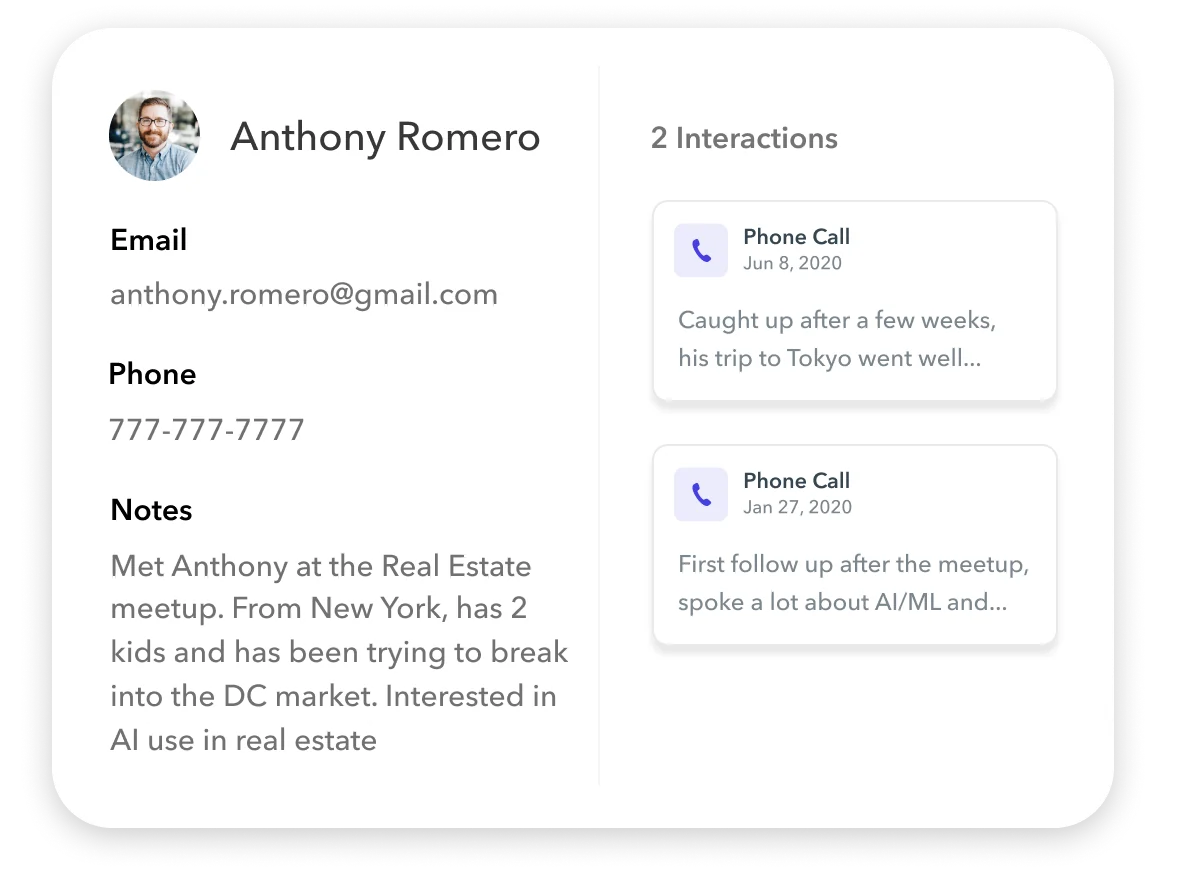
Group people by shared context
Use groups that tell you why a conversation exists:
- Customers who teach us: design partners, early users, and buyers whose experience changes the product.
- Current investors: people already committed to the company, with communication expectations agreed elsewhere.
- Potential capital relationships: people getting to know the company, whether or not a raise is active.
- Advisors and specialist operators: people who can challenge a decision from relevant experience.
- Founder peers and connectors: people with whom help, pattern recognition, and introductions move both ways.
Do not rank people as “high value.” Carta’s current investor guidance argues that the working relationship with the individual partner can matter more than the firm’s name, and recommends asking other founders about the investor’s expertise, network, and track record. Record evidence of fit, not status.
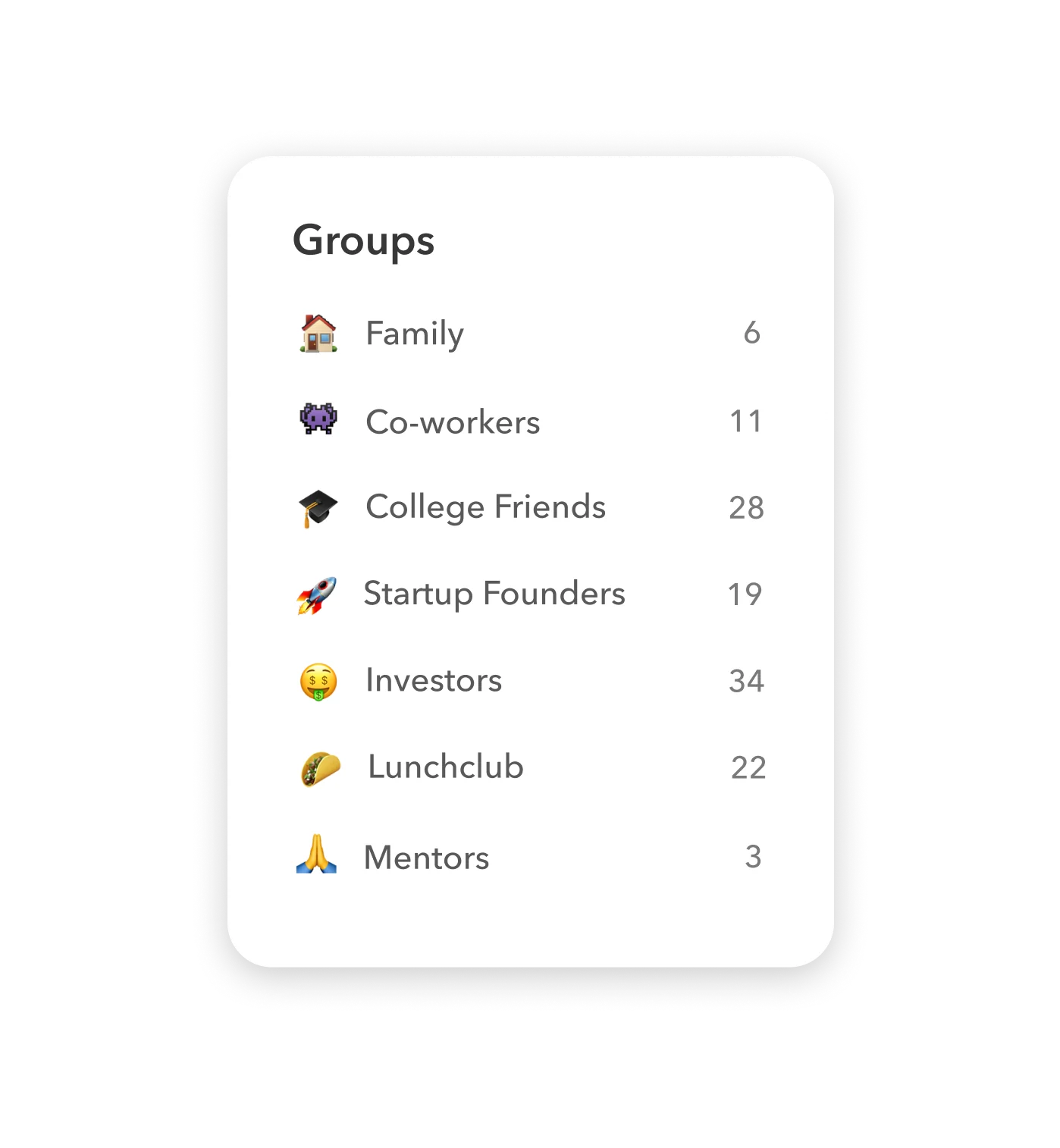
Suggested fields
| Field | What belongs there |
|---|---|
| Relationship context | How you met and what created mutual relevance |
| Current focus | What the person is working on, in their words |
| Last useful insight | The idea that changed a product, hiring, market, or financing decision |
| Their ask | What they explicitly requested, if anything |
| My promise | The introduction, answer, document, or update you owe |
| Next moment | One action, date, or milestone—not “stay in touch” |
| Permission and boundary | What may be shared, preferred channel, or topics to avoid |
Keep customer secrets, employee matters, legal advice, board material, deal terms, credentials, and private documents out. A short relationship note should still be safe if it appears on the wrong screen.
A founder cadence that follows the work
- After a substantive conversation: spend two minutes recording the insight, promise, and next moment.
- Every Friday: review open promises. The system earns its place by preventing broken commitments.
- Before an investor update: check which current investors offered relevant help and which prior asks need a result. Carta lists trajectory, metrics, hiring, customer wins, and specific asks as common update material; the actual update belongs in your approved investor-communications workflow.
- After a real milestone: close the loop with the person who helped create it. Ask permission before naming a customer or forwarding someone’s advice.
- Each quarter: archive stale records, correct roles, and reconsider whether each reminder still serves a relationship.
This is not a license to message everyone monthly. Stripe’s guide notes that long-term relationships can survive infrequent contact; the point is a concrete, respectful follow-up.
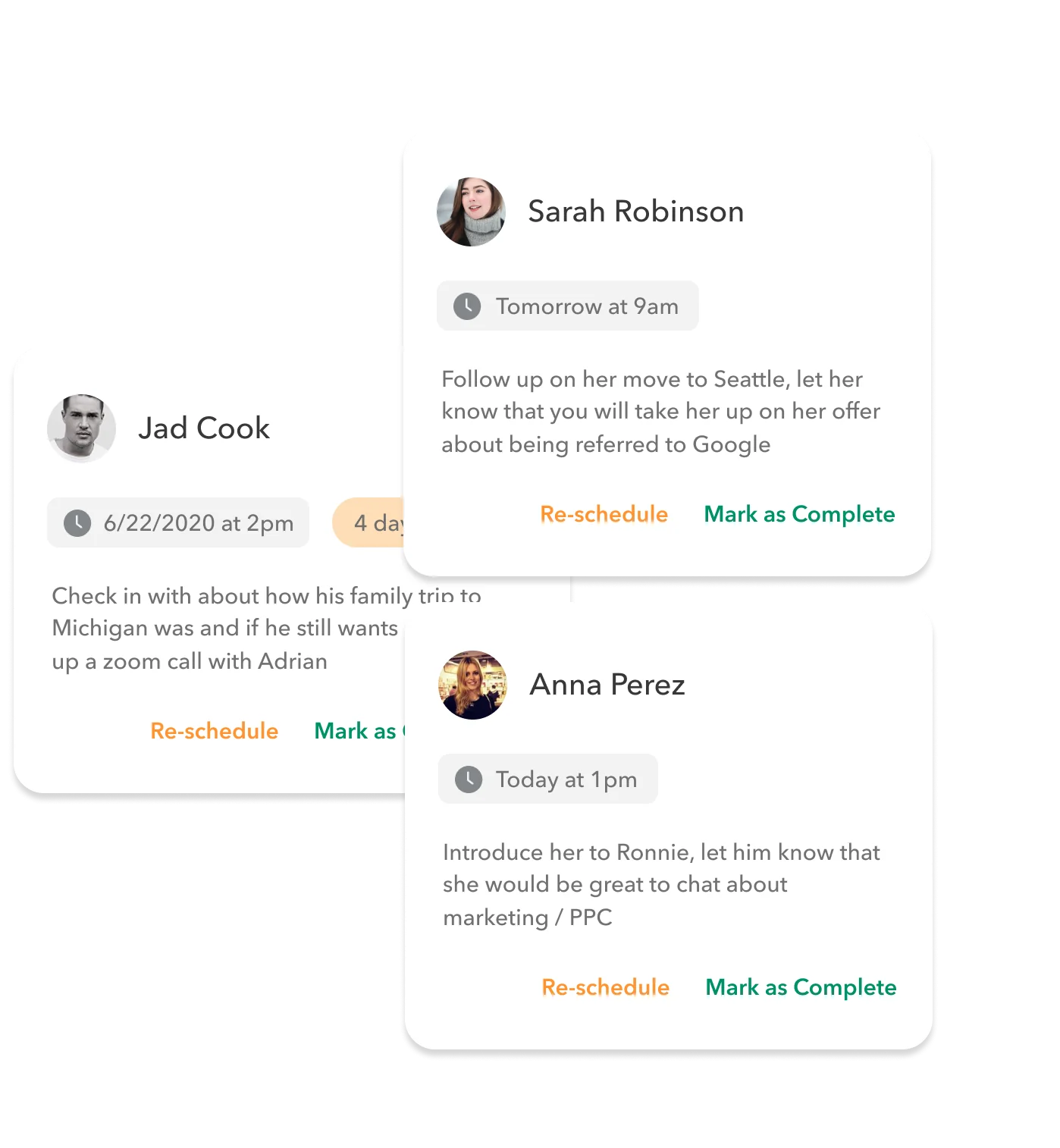
A concrete five-step workflow
- Capture the sentence that matters. What did this person see that you had missed?
- Name the promise. Convert “follow up” into “send the revised onboarding flow on Thursday.”
- Put company work in the company system. Product feedback goes to the product process; a sales opportunity goes to the sales CRM; fundraising status goes to the raise tracker.
- Do the work before asking again. Advice only compounds when it changes behavior.
- Close the loop. Share the outcome, thank the person, and set another reminder only if a next moment is real.
Stripe’s John Doerr AMA similarly recommends researching investors, getting thoughtful introductions where possible, and leaving meetings with clear timing and next steps. The CRM should make that clarity visible; it cannot create it.
A realistic example
Imani is building scheduling software for home-care agencies. A customer operations lead explains that last-minute caregiver substitutions—not initial scheduling—cause the most painful calls. Imani records the insight and promises a revised prototype next Tuesday. The account and opportunity remain in the company’s sales CRM.
An advisor introduces an operator who has managed the same problem. Imani asks before sharing any customer context, keeps the discussion hypothetical, and records one principle: show who approved a substitution and when. Two weeks later, the customer tests the revision. With permission, Imani tells the advisor that the introduction changed the workflow.
A potential investor had asked what the team was learning from early users. Imani shares the general product lesson during their next scheduled conversation—not the customer’s identity or private operating data. One insight produced three properly bounded follow-throughs.
Mistakes that turn memory into noise
- Mixing relationships with pipelines: people can outlast a deal, round, or company.
- Importing everyone: a large empty database adds maintenance, not judgment.
- Recording gossip or private detail: relevance is not permission.
- Using reminders as automated pressure: a timer is not a reason to contact someone.
- Treating customers as fundraising evidence: ask before sharing names, logos, quotes, or identifiable stories.
- Letting fundraising consume the company: YC’s seed guidance treats fundraising as a focused process; relationship maintenance should not become permanent theater.
When Mogul is the wrong tool
Use a dedicated system when the job requires shared deal stages, email sequences, pipeline reporting, cap-table accuracy, board approvals, diligence access controls, or a team-owned customer history. Do not duplicate those records in a personal app.
If automatic contact capture matters more than deliberate entry, compare Mogul and Dex. If self-hosting and control of the application stack are requirements, read Mogul and Monica. The broader personal CRM shortlist explains the tradeoffs, and the investor workflow shows the other side of these conversations.
Frequently asked questions
Should a founder add every investor they meet?
No. Add someone after a substantive exchange, a specific introduction, or an invited next step. A scraped name is research data, not a relationship.
Is this also my fundraising CRM?
No. During an active raise, use a purpose-built tracker for firm, partner, stage, materials, decision, and next meeting. The personal CRM can retain the durable human context after the process ends.
How often should I update investors?
Agree on a cadence with current investors and use the company’s approved communication process. Potential investors should receive updates only when invited or when a genuinely relevant milestone creates a reason.
What should I store about customers?
Store the relationship context, a safe summary of the lesson, your promise, and permission boundaries. Keep account history, sensitive feedback, usage data, and commercial details in company-controlled systems.
Can cofounders share one personal CRM?
If multiple people need the same source of truth, choose a team-owned CRM or approved workspace. A private relationship memory should never become an unofficial shared operating system.